Leading the Way: JBLCF’s Employees’ Anti-Bullying Policy as a Model for a Safe, Respectful, and Inclusive Workplace

Michelle Jean C. Villanueva, MAEd
Human Resource Head
John B. Lacson Colleges Foundation – Bacolod, Inc.
"Respect is not something you demand, it’s something you build. A healthy workplace thrives when everyone feels safe to speak, create, and contribute. It does not just happen by accident; it is built intentionally through everyday acts of kindness, accountability, and mutual respect.”
Rationale
John B. Lacson Colleges Foundation – Bacolod, Inc. is committed to maintaining a safe, respectful, inclusive, and harmonious work environment for all employees. As an educational institution, the school recognizes that every employee deserves to work in a workplace where dignity, professionalism, and mutual respect are upheld at all times.
Workplace bullying, harassment, intimidation, and other forms of abusive behavior can negatively affect the well-being, morale, and productivity of employees. Such behaviors may also disrupt teamwork, weaken employee engagement, and affect the overall working relationship within the institution.
The adoption of the Employees’ Anti-Bullying Policy was undertaken as a proactive measure to strengthen workplace discipline, promote respect among personnel, and provide a clear mechanism for addressing bullying and other abusive conduct. This best practice also supports the institution’s continuing commitment to employee welfare, ethical conduct, and a positive organizational culture.
Basis of the Best Practice
The Employees’ Anti-Bullying Policy was developed based on the recommendation from the research study entitled “Unveiling Workplace Bullying: Understanding Experiences, Impacts, and Mediating Actions,”conducted by Irene Mamon and Michelle Jean C. Villanueva.
The policy is also aligned with relevant national laws and regulations, including Republic Act No. 11058 or the Occupational Safety and Health Standards Law, the Labor Code of the Philippines, Republic Act No. 11313 or the Safe Spaces Act, Republic Act No. 7877 or the Anti-Sexual Harassment Act, Civil Service Commission rules, and applicable Department of Labor and Employment guidelines.
Department’s Best Practice
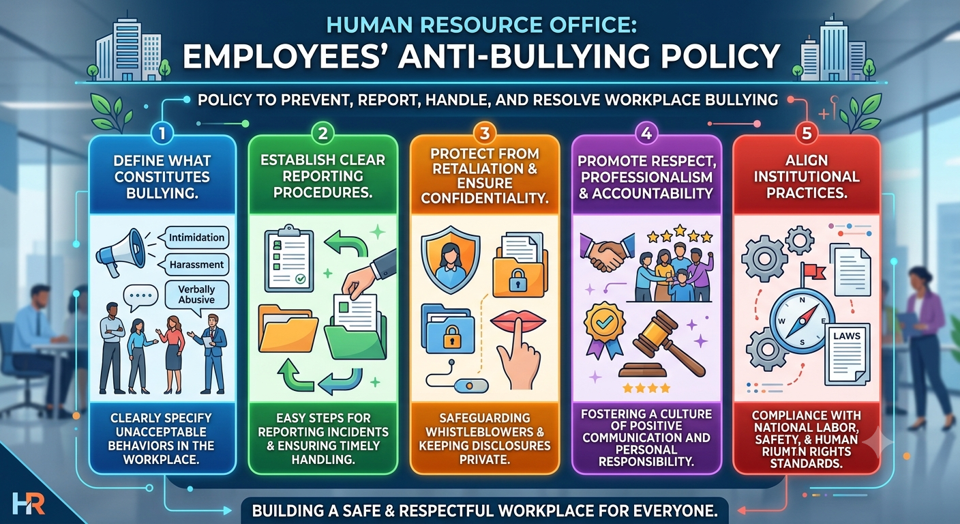
The Human Resource Office developed and adopted the Employees’ Anti-Bullying Policy to provide clear guidance on preventing, reporting, handling, and resolving workplace bullying incidents. To achieve this, the policy aims to define what constitutes workplace bullying, establish clear procedures for reporting and addressing incidents, and protect employees from retaliation while ensuring strict confidentiality. Furthermore, it seeks to promote a culture of respect, professionalism, and accountability among all personnel, ultimately aligning institutional practices with national labor, safety, and human rights standards.
Implementation Process
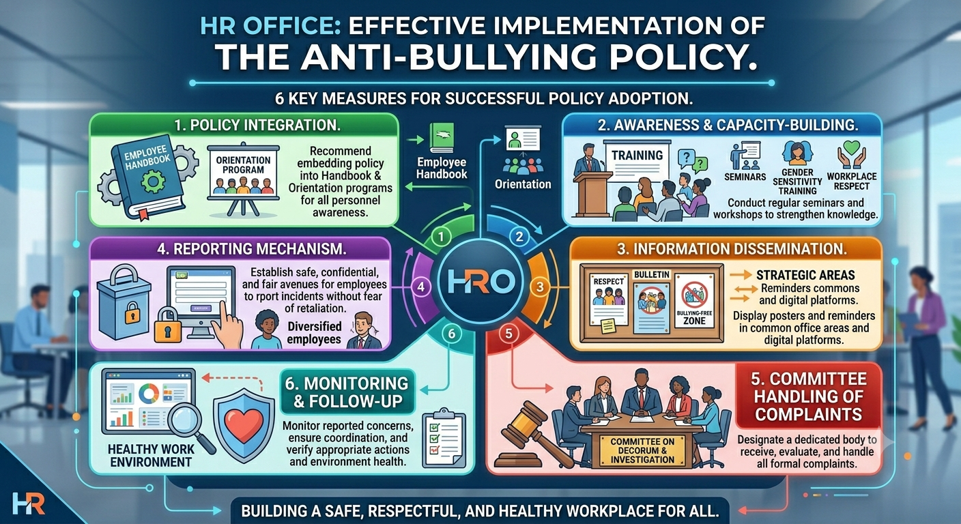
To ensure the effective implementation of the newly adopted Employees’ Anti-Bullying Policy, the Human Resource Office has established a comprehensive framework comprising six key measures. First, a thorough policy integration recommends embedding the policy into the formal Employee Handbook and all new employee orientation programs, ensuring all personnel are legally and culturally informed of their rights and expected conduct from day one. This foundation is reinforced through continuous awareness and capacity-building activities, such as mandatory seminars and training orientations focused on workplace respect, gender sensitivity, and professional behavior to proactive strengthen employee knowledge.
Simultaneously, an information dissemination campaign utilizes visible posters and strategic reminders across the workplace to maintain a constant presence promoting a bullying-free environment. Effective reporting requires trust; thus, a safe and trusted reporting mechanism is established, where employees are strongly encouraged to report incidents without any fear of retaliation, with absolute guarantees that all reports are handled with confidentiality, fairness, and strict due process. Complaints are not left vague but are instead managed by a dedicated committee, ensuring a standardized, neutral body that evaluates and manages delicate situations involving harassment or abuse. Finally, ongoing monitoring and follow-up are critical, with HR actively tracking all reported concerns and coordinating with other departments to ensure appropriate actions are enforced and that the working environment remains healthy, supportive, and respectful for all staff.
Benefits Derived from the Best Practice
The adoption of the Employees’ Anti-Bullying Policy has helped strengthen the Human Resource system by providing a clear and structured approach to addressing workplace concerns. It promotes fairness, accountability, and professionalism among employees. This best practice has contributed to:
* Greater awareness of respectful workplace behavior;
* Clearer procedures for reporting and handling complaints;
* Stronger protection for employees against bullying and retaliation;
* Improved employee confidence in raising workplace concerns;
* Promotion of a positive and harmonious working environment; and
* Strengthened compliance with labor, safety, and human rights standards.
Through this initiative, the institution continues to build a workplace culture where employees feel safe, valued, respected, and empowered.
Stakeholders’ Feedback
The Employees’ Anti-Bullying Policy benefits all employees of JBLCF-Bacolod by providing them with a safer and more supportive work environment. Feedback from employees and stakeholders reflects the importance of having a clear policy that protects personnel, promotes respectful communication, and strengthens trust in the institution’s grievance and intervention mechanisms. The policy also supports department heads and supervisors by guiding them in addressing concerns in a fair, confidential, and professional manner.
Suggestions and Recommendations
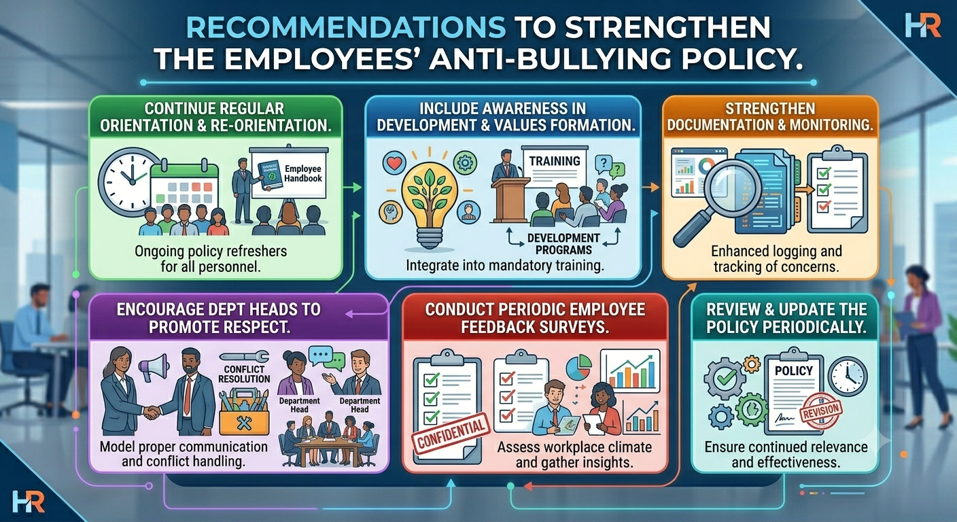
To further strengthen the implementation of the Employees’ Anti-Bullying Policy, the following recommendations are proposed:
- Continue regular orientation and re-orientation of employees on the policy;
- Include anti-bullying awareness in employee development and values formation programs;
- Strengthen documentation and monitoring of workplace concerns;
- Encourage department heads to promote respectful communication and proper conflict management within their respective offices;
- Conduct periodic employee feedback surveys to assess workplace climate; and
Review and update the policy when necessary to ensure its continued relevance and effectiveness.
Acknowledgment
The Human Resource Office acknowledges the support of the Administration, department heads, faculty, and staff in promoting a safe, respectful, and inclusive workplace. Appreciation is also extended to those who contributed to the research study and to the development of this policy as part of the institution’s commitment to employee welfare and organizational excellence.
Through this best practice, JBLCF-Bacolod continues to uphold its commitment to a workplace culture anchored on respect, dignity, professionalism, and care for every employee.